
Healthy leg veins carry blood upward against gravity, and small one-way valves keep it from falling back down. When those valves fail, blood pools in the leg. Pressure builds in the vein wall, the vein stretches and twists, and the visible rope under the skin appears. The bulge you can see is the last step in the process, not the first.
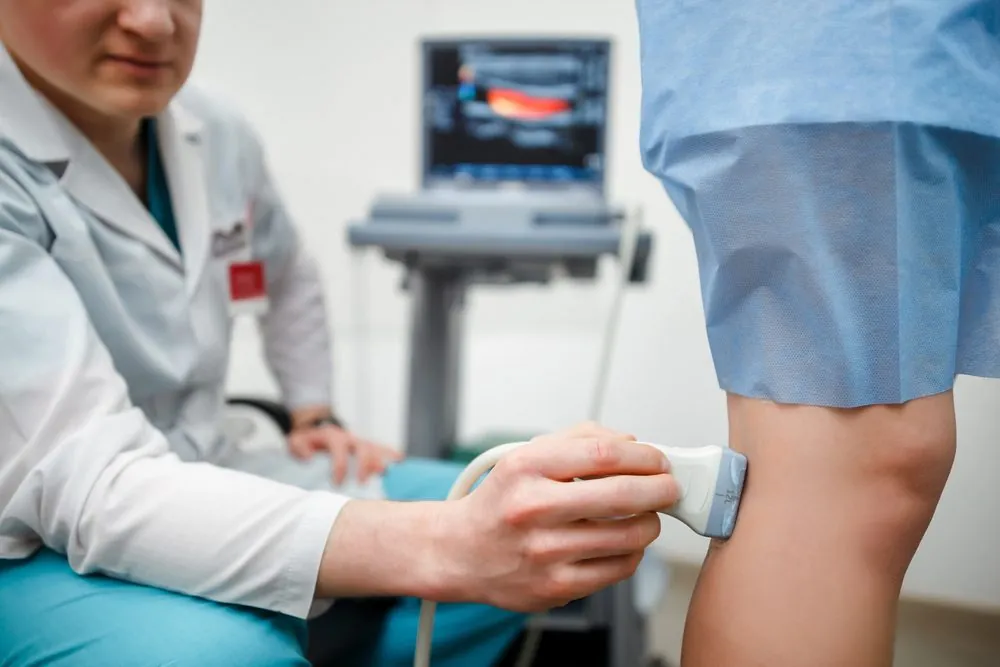
That is why treating only what is visible so often disappoints. If the underlying refluxing vein is left alone, the problem returns. Every evaluation here begins with a duplex ultrasound that maps which veins have failed and in what order, so treatment is aimed at the cause rather than the symptom.
Left untreated, venous reflux tends to progress: aching and heaviness at the end of the day, then swelling, then skin discoloration around the ankle, and in some patients a venous ulcer that will not heal. Treating the vein early is a great deal simpler than treating the skin damage that follows it.
We image the deep and superficial systems in the standing position, where reflux actually shows itself, and identify exactly which segments have failed.
Depending on the vein's size, depth and course, we close it with endovenous laser (EVLT), radiofrequency ablation, medical adhesive closure or foam sclerotherapy. Each is delivered through a needle puncture under local anesthesia.
Once the source is closed, the visible tributaries are addressed with micro-phlebectomy or sclerotherapy, usually at a second short visit.
You walk immediately after treatment. Walking is part of the treatment — it keeps the deep system moving while the closed vein reabsorbs.
Most patients are good candidates for more than one method. This is how the options compare; the right one depends on the size, depth and course of the failing vein, which the ultrasound shows.
| Treatment | How it works | Anesthesia | Best suited for | Back to normal activity |
|---|---|---|---|---|
| Endovenous laser ablation (EVLA, EVLT) | A thin laser fiber heats and seals the vein from the inside | Local, with numbing fluid around the vein | Large, straight trunk veins such as the great and small saphenous veins | Walking right away; most people work the next day |
| Radiofrequency ablation (RFA) | A catheter delivers controlled heat in short segments to close the vein | Local, with numbing fluid around the vein | Trunk veins; often a little less bruising than laser | Walking right away; most people work the next day |
| Medical adhesive closure | A small amount of medical-grade adhesive glues the vein shut | Local at the entry point only | Trunk veins, especially near nerves, or when you would rather skip the numbing injections | Walking right away; compression often not required |
| Foam sclerotherapy | A medication foam irritates the vein lining so it scars closed | None | Twisting branch veins, recurrent veins and spider veins | Same day |
| Micro-phlebectomy | Bulging branches are removed through tiny nicks that need no stitches | Local | Large, rope-like surface veins after the trunk vein is closed | A day or two |
| Surgical stripping (for comparison) | The vein is tied off and pulled out through incisions | General or spinal, in a hospital | Now rarely needed | One to several weeks |
You are likely a candidate if you have symptoms such as aching, heaviness, swelling, night cramps, skin changes or an ulcer, and the ultrasound shows reflux: blood falling backward for longer than half a second in a superficial vein. Visible varicose veins without symptoms can also be treated, though insurance usually treats that as cosmetic.
Treatment may be postponed during pregnancy, while a deep vein clot is still active, or when walking is not yet possible. A history of deep vein thrombosis does not rule treatment out; it changes how we plan it.
The 2023 clinical practice guidelines of the Society for Vascular Surgery, the American Venous Forum and the American Vein and Lymphatic Society recommend endovenous ablation over open surgery for symptomatic saphenous vein reflux, because recovery is faster and there is less pain with similar long-term results.
In the EVRA trial, published in the New England Journal of Medicine in 2018, patients with venous leg ulcers who had their refluxing vein treated early healed faster than patients managed with compression alone and spent more time ulcer-free afterward.
Thermal ablation closes the treated vein in more than nine out of ten cases in most published series. New varicose veins can still appear over the years, which is why we follow patients with ultrasound.
Bruising, tenderness and a pulling sensation along the treated vein are common and fade over a few weeks. Less often, the vein becomes inflamed (phlebitis), a patch of skin feels numb for a while, or the skin darkens along a treated branch. A clot extending from the treated vein into a deep vein is rare; a follow-up ultrasound within the first week is done to check for it. After adhesive closure, a few people develop a mild skin reaction over the vein.
We accept most insurance, including Medicaid plans and Medicare. Varicose vein treatment is covered when it is medically necessary, which usually means symptoms plus reflux documented on ultrasound. Some plans also ask for a trial of compression stockings first. Spider vein treatment for appearance alone is not covered. Our team verifies your benefits and obtains any prior authorization before treatment is scheduled.
You walk out of the office and drive yourself home. Most people return to work the next day. Compression stockings are worn for a short period afterward, and strenuous exercise is usually held for about a week. Bruising along the treated vein is normal and fades over two to three weeks.
The treated vein is sealed and the body gradually reabsorbs it. Blood reroutes through healthy veins immediately — a refluxing vein was already moving blood the wrong way, so closing it improves circulation rather than compromising it.
When varicose veins cause symptoms — pain, swelling, skin changes, bleeding or ulceration — treatment is generally covered, usually after a documented trial of conservative measures. Purely cosmetic spider vein treatment is not. We verify your specific benefits before scheduling.
A properly closed vein does not reopen in most cases. Venous disease is a tendency, though, and new veins can become incompetent over time, particularly with pregnancy, prolonged standing or family history. Follow-up ultrasound catches this early, when it is a small problem.
No. Everything is done under local anesthesia in the office. You are awake, comfortable and walking within minutes of finishing.
They close the vein at similar rates. Laser and radiofrequency use heat and need numbing fluid around the vein; adhesive needs no heat and only one needle stick. The choice depends on the vein's size, depth and closeness to nerves, and on your insurance, since coverage for adhesive closure varies by plan.
Closing a trunk vein usually takes under an hour in the office, including ultrasound mapping and preparation. You walk out on your own afterward.
Yes. Both legs are usually treated at separate visits, often a week or two apart, so you always have one leg free of bruising and soreness.
Yes. A short ultrasound within the first week confirms that the vein is closed and that the deep veins are clear. Later scans check for any new reflux.
Tell us what you're experiencing. We'll call to schedule and answer questions before you ever come in.
(212) 991-9991Fax (888) 331-9568
Please call the office to request an appointment or discuss the next step. Do not send medical information by ordinary email. For a medical emergency, call 911.
