
Benign prostatic hyperplasia is not dangerous, but it is relentless. The prostate enlarges, squeezes the urethra running through it, and the bladder spends years fighting to push urine past the obstruction. The result is the familiar list: a weak stream, hesitancy, straining, a stream that stops and starts, the sense that the bladder never quite empties, and the nightly trips to the bathroom that quietly wreck sleep.
Conventional surgical treatments work by removing or destroying prostate tissue from inside the urethra. They are effective, but they involve instrumenting the urethra, they usually require a catheter afterward, and they carry a meaningful rate of retrograde ejaculation and other sexual side effects.
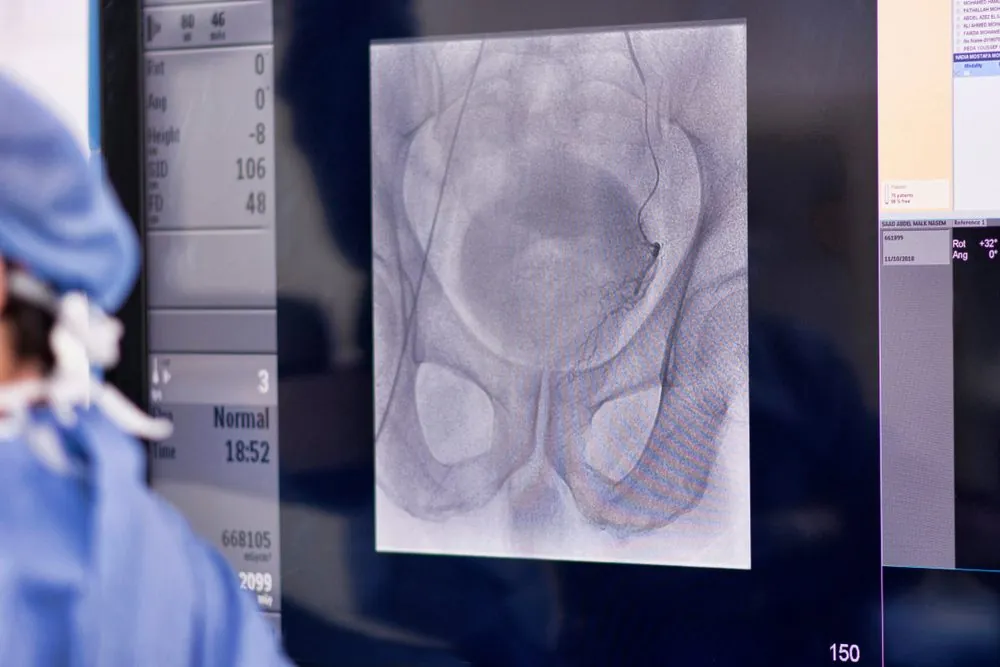
Prostate artery embolization takes an entirely different route. We reach the prostate through its arteries and reduce its blood supply. Deprived of that supply, the gland shrinks over the following weeks and the pressure on the urethra falls. The urethra is never instrumented. In our practice, patients go home the same day without a urinary catheter.
The team here is unusual in this respect: Dr. Golowa was a co-investigator in the early United States clinical trials of PAE and performed his first case in São Paulo in 2013 under one of the physicians who pioneered the technique. Between our centers we have performed well over a thousand of these procedures.
Both specialties see you. That matters — the decision about whether PAE is the right choice, or whether a different BPH treatment fits you better, should be made by people who can offer all of them.
A needle enters the artery at the wrist or groin. A microcatheter is guided to the arteries supplying the prostate under live imaging.
Microscopic particles are released into the prostatic arteries, reducing the gland's blood supply. Both sides are treated in the same sitting.
The microcatheter is removed. There is no incision to close and nothing left behind. Symptoms improve gradually over the following weeks as the prostate shrinks.
Home the same day, generally without a urinary catheter. Most men return to desk work within a day or two. Some experience a few days of pelvic pressure, urinary frequency or a low-grade fever as the prostate responds; this is expected and settles. Symptom improvement builds over four to twelve weeks.
PAE does not instrument the urethra and is not associated with the retrograde ejaculation that commonly follows transurethral surgery. Every patient's situation deserves an individual discussion, and we will have that discussion honestly before you decide anything.
In our practice, no. Avoiding the urethral catheter is one of the central advantages of this approach over transurethral surgery.
Not overnight. The prostate shrinks progressively as its blood supply is reduced, and most men notice steady improvement between four and twelve weeks, with the full effect at around six months.
Yes. PAE does not preclude any future treatment. That is one of the reasons it is an attractive first step for many men.
Tell us what you're experiencing. We'll call to schedule and answer questions before you ever come in.
(212) 991-9991Fax (888) 331-9568
Please call the office to request an appointment or discuss the next step. Do not send medical information by ordinary email. For a medical emergency, call 911.